Click here to download OMQ’s Style Guide as a PDF
TEXT FROM IMAGE ABOVE:
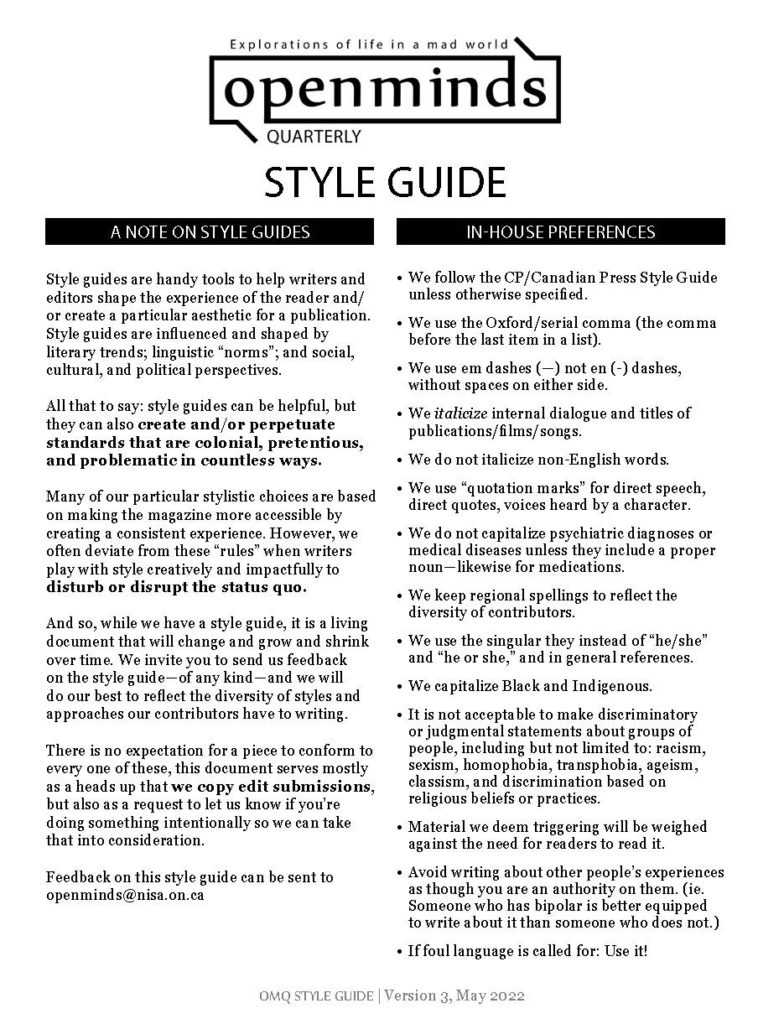
Style guides are handy tools to help writers and editors shape the experience of the reader and/or create a particular aesthetic for a publication. Style guides are influenced and shaped by literary trends; linguistic “norms”; and social, cultural, and political perspectives.
All that to say: style guides can be helpful, but they can also create and/or perpetuate standards that are colonial, pretentious, and problematic in countless ways.
Many of our particular stylistic choices are based on making the magazine more accessible by creating a consistent experience. However, we often deviate from these “rules” when writers play with style creatively and impactfully to disturb or disrupt the status quo.
And so, while we do have a style guide, it is a living document that will change and grow and shrink over time. We invite you to send us feedback on the style guide—of any kind—and we will do our best to reflect the diversity of styles and approaches our contributors have to writing.
There is no expectation for a piece to conform to every one of these, this document serves mostly as a heads up that we do copy edit submissions, but also as a request to let us know if you’re doing something intentionally so we can take that into consideration.
Feedback on this style guide can be sent to [email protected]
(Continue onto page two for in-house preferences)
- We follow the CP/Canadian Press Style Guide, unless otherwise specified.
- We use the Oxford/serial comma (the comma before the last item in a list).
- We use em dashes (—) not en (-) dashes, without spaces on either side.
- We italicize internal dialogue and titles of publications/films/songs.
- We do not italicize non-English words.
- We use “quotation marks” for direct speech or direct quotes only.
- We do not capitalize psychiatric diagnoses or medical diseases unless they include a proper noun—same for medications.
- We keep regional spellings to reflect the diversity of contributors.
- We capitalize Black and Indigenous.
- It is not acceptable to make discriminatory or judgmental statements about groups of people, including but not limited to: racism, sexism, homophobia, transphobia, ageism, classism, and discrimination based on religious beliefs or practices.
- Material that could be triggering will be weighed against the need for readers to read it.
- Avoid writing about other people’s experiences as though you are an authority on them. (ie. Someone who has bipolar would be better equipped to write about it than someone who does not.)
- If foul language is called for: Use it!